Ruth Warnecki’s cave ordeal
Point BlankRuth Warnecki’s cave ordeal turns a methodical search for Civil War treasure into a physical and psychological crisis that leaves her injured, lost, and unable to remember her identity. Her entry into Winkel’s Cave also has consequences beyond her own survival: Dixon Noble later recognizes that, without Ruth’s cave exploration, Erin Bushnell might have vanished without a trace. The ordeal thus joins a private struggle against darkness and panic to the book’s wider mysteries of disappearance, memory, and unresolved loss.
The search and the hidden entrance
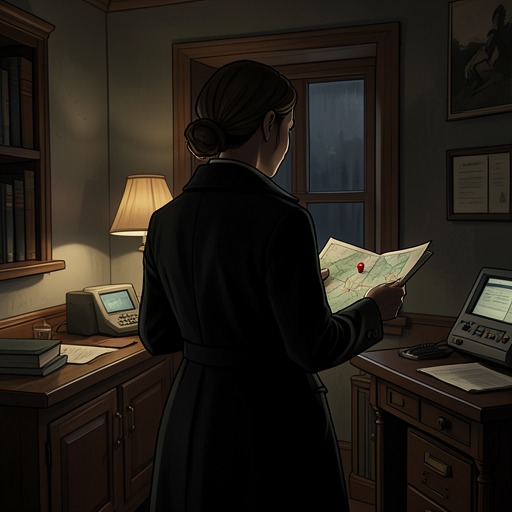
On Friday afternoon in Winkel’s Cave, Ruth follows a well-used treasure map through a narrow, twisting passage. The map is worn and stained, even marked with strawberry jam, but she has measured the route carefully: the first 46.2 feet match its instructions, and the distances she has checked so far agree to the centimeter. She expects an arched opening in the wall. Instead, her headlamp reveals only limestone. She searches the indicated area, feels along the dry stone, and finds no sign of an entrance. Her frustration takes the form of humming rather than cursing.
Ruth knows that treasure maps are often fraudulent. Her uncle Tobin Jones, a treasure hunter and mentor, has taught her to expect far more false maps than genuine ones, and she has researched this one closely. The paper, ink, and handwriting appear to be about 150 years old; the map came among nineteenth-century books she bought in Manassas. Her equipment and habits reflect caution as much as excitement: she carries a portable metal detector, extra flashlights, a headlamp, and measuring tools, and she checks distances rather than trusting the map blindly.
The absence of the arch does not immediately end the search. Ruth eventually finds and breaks through a concealed limestone barrier into the chamber she believes the map describes. The opening is only about the size of a St. Bernard’s dog door, but wide enough to look through and squeeze into. She expects a chamber roughly thirty feet across and forty feet wide. Once inside, however, her lights reveal no opposite wall. Her compass indicates that the wall should lie due east, yet the chamber seems to stretch into unreflective darkness. The discrepancy is the first sign that the space she entered cannot be reconciled with the map’s reassuring measurements.
Disorientation in the chamber
The chamber’s air is unexpectedly fresh rather than stale, with a faintly sweet smell. Ruth supposes that an unmapped exit may account for it, but she also begins to feel dizzy and heavy in her limbs. She proceeds carefully, testing the ground with her hands and taking precautions against traps. Her ordinary tools no longer restore confidence: light finds no boundary, and her expectations of a small, enclosed room give way to an apparent expanse without an edge.
Ruth tries to measure the darkness. When her extended tape measure still does not reach a wall, she reasons that she must have crawled off course, then circles with the tape fully extended. Nothing interrupts its reach. Dizziness and nausea intensify; she sits on the floor, breathing shallowly, with her mouth dry and her heart pounding. Her mind supplies an image of a void larger than anything she can imagine, and she struggles to separate that terror from the practical possibility that she has simply entered a larger chamber than the map shows.
She attempts to regain control by slowing her breathing and following the tape back toward a known point. Ruth also tells herself that the map may be lying or that she may have entered the wrong arch. Yet neither explanation accounts for the fresh air. Her struggle is not simply to find a route: it is to keep a stable interpretation of the cave, her instruments, and her own perceptions. At her most frightened, she invokes her father as a warning to herself, and hearing her own voice helps calm her enough to think again. The map, tape, compass, and voice—things that ordinarily anchor her to measurable reality—become tests of whether such an anchor still exists.
Rescue and loss of identity
After the cave ordeal, Dixon Noble’s dog Brewster barks at a dark shape on the snowy forest floor. Dixon puts the dog inside his jacket, kneels beside the motionless person, and turns her over. The woman’s face is covered with blood. He wipes it away with snow and finds a wound on the side of her head, still bleeding slowly. Her pulse is slow but steady, so he speaks to her and urges her to wake.
When Ruth comes around, she recognizes neither her name nor her identity. She nuzzles against Brewster and says that she has no idea who she is. Dixon introduces himself as the sheriff of Maestro and explains that his son Rob Noble made the tea. He suggests that the blow to her head may explain her memory loss and tries to reassure her while they wait for medical help. Ruth has no identification in her pockets; she cannot recall whether she had a purse or wallet, and Dixon plans to search the woods for a purse the next day. The rescue restores her to human company, but it does not immediately restore her past.
Consequences for the investigation and family
Ruth’s cave exploration becomes significant to the investigation of Erin Bushnell’s death. Dixon later observes that, had Ruth not gone treasure hunting in Winkel’s Cave that day, Erin might simply have disappeared, leaving no clue as to whether she had left voluntarily or been taken. The cave ordeal therefore does more than put Ruth in danger: her presence and discovery in the cave make a concealed crime visible and give the investigation a starting point.
The discovery also touches Dixon’s own history. When the FBI agents discuss how Erin might otherwise have vanished, Ruth recognizes the connection to Dixon’s wife, Christie Noble. Dixon tells them Christie disappeared nearly three years earlier. A large criminal investigation and a private detective produced no clue or lead, and from the moment Ruth found Erin, Dixon had wondered whether Christie had suffered the same fate. The cases are not established as connected, but the resemblance makes the uncertainty surrounding Christie newly immediate.
Ruth’s recovery brings her into Dixon’s household. After living with him and his boys for a week, she finds that their life together feels increasingly natural; when Dixon calls the place home for both of them, the word unsettles her even as it makes her feel good. She believes Christie would not willingly have left Dixon and the boys, and senses that something terrible happened to her. Later, when Dixon kisses Ruth, Rob identifies the unspoken issue as his mother. Dixon acknowledges that the kiss was intentional and tells his sons he must eventually move forward, while also confronting how they have kept painful fears about Christie to themselves.
Dixon insists that Christie would never have abandoned them, says he believes she is dead, and admits that he has searched without finding an explanation. His honesty marks a change in the family’s way of carrying the disappearance: rather than preserving an uncertain hope by keeping the subject buried, he tells the boys what he believes and promises never to stop seeking the truth. Ruth’s ordeal does not solve Christie’s disappearance, but it places her close to the family’s unresolved loss. Its lasting significance lies in that double movement: Ruth emerges from a cave unable to name herself, then becomes part of a household trying to face the unknown surrounding someone it cannot name as either safely gone or conclusively found.